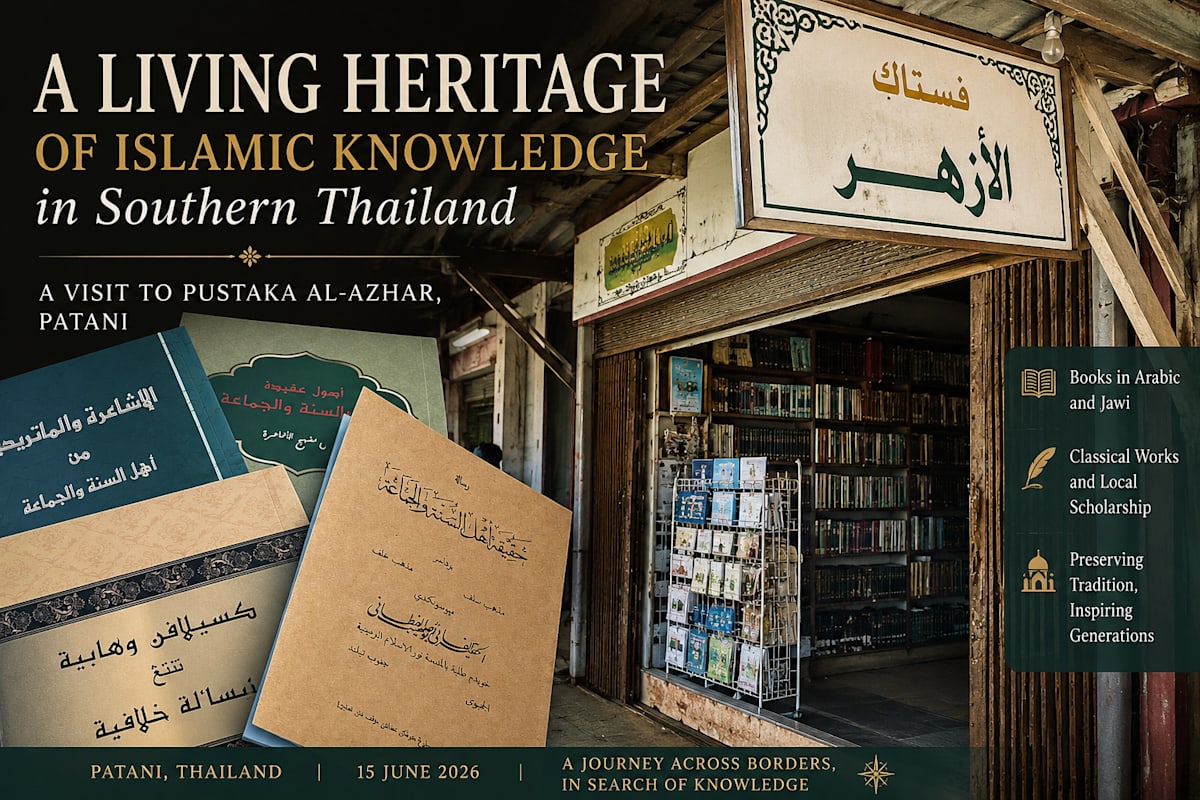
On June 15, 2026, during my journey from Songkhla to Kota Bharu, I stopped at a small bookstore named Pustaka Al-Azhar. The visit was not originally planned as an academic observation. However, sometimes the most meaningful encounters with knowledge happen in unexpected places.
I was accompanied by Abdul Rooya Panaemale, a writer from Patani who has a deep understanding of the cultural and intellectual traditions of Southern Thailand. Our journey took us from Patani toward the Sungai Kolok border before I continued my return to Kuala Lumpur. Along this route, we entered a space that quietly preserved an important chapter of the Malay Muslim intellectual world.
At first glance, Pustaka Al-Azhar looked like a modest bookstore. It did not carry the appearance of a large commercial bookstore found in modern cities. Yet behind its simplicity, it contained a rich collection of Islamic texts that reflected centuries of scholarly transmission in the region.
The owner of this bookstore is an alumnus of Al-Azhar University in Egypt. This background immediately explains the intellectual atmosphere of the place. The bookstore was not established merely as a commercial activity. It represents a continuation of the relationship between the Malay Muslim world and one of the most influential centers of Islamic learning.
Inside the bookstore, I found various works written in Arabic and Jawi. I purchased several books, including works related to religious guidance, ethics, and Islamic knowledge. These books are still used and read by students of knowledge in Southern Thailand.
For many people today, these books may appear ordinary. They may only see printed pages and traditional scripts. However, for those who understand the history of knowledge in the Malay world, these books represent something deeper. They are traces of an intellectual civilization.
Jawi was never merely a writing system. For centuries, it functioned as the language of knowledge among Malay Muslim societies. Through Jawi, scholars transmitted Islamic teachings, philosophical reflections, legal discussions, and spiritual guidance to their communities.
From Aceh to Patani, from the Malay Peninsula to various parts of Southeast Asia, Jawi became a bridge connecting local societies with the wider Islamic intellectual tradition. It allowed ideas from the broader Muslim world to enter local cultures without removing their unique identities.
This is why the existence of bookstores like Pustaka Al-Azhar remains significant. They preserve not only books but also memories. They remind us that knowledge is not only produced in universities or modern institutions. It is also maintained in small spaces where teachers, students, and communities continue their intellectual traditions.
One of the most interesting aspects of this bookstore was the availability of works written by local scholars. This shows that Southern Thailand was not merely a receiver of Islamic knowledge from outside. It has its own tradition of producing scholars, texts, and interpretations.
The Islamic tradition in Patani has a long history. For generations, scholars from this region contributed to the development of religious learning in Southeast Asia. Their works traveled beyond political borders and became part of the shared intellectual heritage of the Malay world.
In the modern era, however, this tradition faces new challenges. Younger generations increasingly live within a digital environment. Knowledge is now accessed through smartphones, search engines, and artificial intelligence systems. Information can be obtained instantly.
But speed does not always create depth.
The experience of holding these books reminded me that classical learning developed through patience. A student did not simply collect information. A student followed a process of reading, understanding, reflection, and transformation.
Traditional Islamic books were designed not only to provide answers but also to shape the character of the reader. Knowledge was understood as a process that involved the mind, ethics, and spiritual discipline.
This is one of the important differences between information and wisdom.
Information can move quickly. Wisdom requires time.
My visit to Pustaka Al-Azhar was therefore not only about buying books. It became an ethnographic encounter with a living tradition. I witnessed how a small bookstore continues to participate in preserving a larger intellectual world.
In many discussions about globalization, small traditions are often viewed as disappearing. Yet places like this show a different reality. Traditions do not always disappear. Sometimes they survive quietly, away from public attention.
A bookstore can become an archive.
A book can become a bridge.
A script can become the memory of a civilization.
As I continued my journey toward Sungai Kolok and later Kuala Lumpur, I carried these books with a different feeling. They were not simply objects purchased during a journey. They represented voices from a long tradition that continues to speak.
In the age of artificial intelligence and digital transformation, humanity needs innovation. But humanity also needs memory.
Without memory, civilization loses its roots.
Pustaka Al-Azhar reminded me that the Islamic intellectual heritage of Southern Thailand is not only a story of the past. It is still alive — preserved through books, teachers, students, and communities that continue to value knowledge.
Sometimes, the future of a civilization can still be discovered on the shelves of a small bookstore.