Introduction
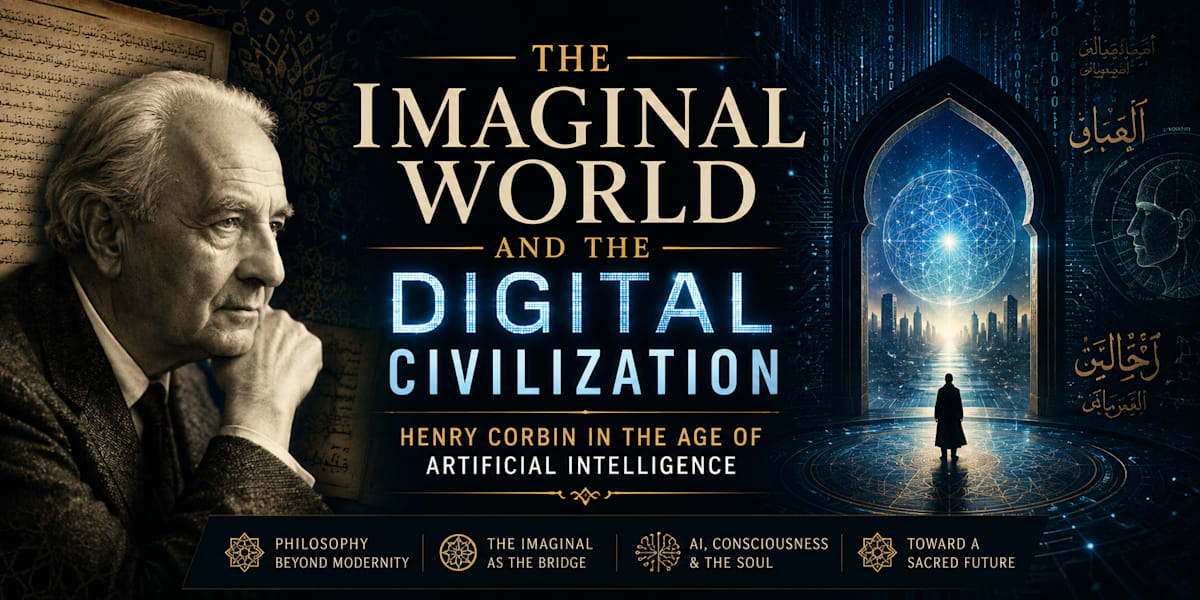
We live in an age of two revolutions. The first is visible: the rise of artificial intelligence, digital platforms, and algorithmic civilization — a transformation so vast it reshapes how human beings think, communicate, and understand themselves. The second revolution is less visible, yet older and deeper: the rediscovery of the imaginal world (mundus imaginalis), a concept developed by the French philosopher and Islamologist Henry Corbin from his deep engagement with Islamic metaphysics, particularly the thought of Ibn Sīnā, Suhrawardī, and Ibn ʿArabī.
At first glance, these two revolutions seem to belong to entirely different worlds. One is computational, materialist, and driven by data. The other is spiritual, hermeneutical, and grounded in the interior depths of human consciousness. Yet a closer reading suggests that they are, in fact, two responses to the same fundamental crisis — the crisis of meaning in modernity.
The Mundus Imaginalis: Beyond the Literal and the Abstract
Henry Corbin introduced the term mundus imaginalis — the imaginal world — to describe a third order of reality that exists between the purely material world of sensory experience and the purely intellectual world of abstract concepts. This is not the world of fantasy or subjective imagination in the modern psychological sense. For Corbin, following Ibn Sīnā's visionary recitals and Suhrawardī's philosophy of illumination, the imaginal world (ʿālam al-mithāl) is an objective, ontologically real domain — the realm in which spiritual realities take form and where the meanings of this world are rooted in a higher intelligible order.
Corbin's great contribution was to show that Islamic metaphysics, far from being simply a commentary on Greek philosophy, constituted an independent and profound engagement with the question of being, reality, and human knowing. The imaginal world was not a poetic metaphor. It was the space in which prophecy, vision, and spiritual transformation were possible — the mediating realm between the angelic and the earthly.
The Digital Civilization and the Abandonment of Inner Reality
In The Digital Civilization: Techno-Religion, the Abandoned Society, and the Crisis of Human Authentic Selfhood in the Planetary Era, I argued that the digital age, far from liberating human beings, has produced what I called the abandoned society — a condition in which the inner life of the person is progressively colonized by external algorithms, virtual identities, and techno-religious narratives of progress.
The digital civilization has created a simulation of the imaginal. Virtual reality, augmented reality, and the metaverse all promise an expanded world beyond the physical senses. Social media creates parallel identities. Artificial intelligence generates text, images, and thought-patterns that mimic human consciousness. Yet all of this is a simulation without interiority — a pseudo-mundus imaginalis built from data rather than from the depths of the human spirit.
The difference is decisive. Corbin's imaginal world is accessed through ta'wīl — spiritual hermeneutics, the return of outward forms to their inner meaning, the soul's ascent through the levels of reality toward the source of all being. The digital world, by contrast, operates through the externalization of data, the reduction of meaning to information, the flattening of experience into metrics.
Rethinking the Human in the Planetary Era
What Corbin's philosophy offers us in the age of artificial intelligence is not a rejection of technology, but a radical reorientation of the question. The real crisis of the digital civilization is not that machines are becoming more intelligent — it is that human beings are becoming less imaginal. We are losing contact with the interior dimension that gives our lives depth, coherence, and sacred significance.
In The Planetary Mind, I explored how global thinkers from Al Gore to Kishore Mahbubani have envisioned a coming convergence of human civilization. But true planetary consciousness, in the Corbinian sense, cannot be built from networks and data alone. It requires what Ibn Sīnā called al-ḥads — the intuitive intellect, the inner faculty that grasps reality directly, not through computation but through illumination.
The task for our civilization, then, is not to choose between tradition and technology, between the sacred and the digital. It is to recover, within the planetary era, the imaginal intelligence that classical Islamic philosophy preserved for centuries — and to bring it into dialogue with the transformations of our time.
Conclusion
Henry Corbin once wrote that the cardinal sin of modernity was the confusio — the confusion of levels of reality, the collapse of the imaginal into the literal. Today, that confusion has reached its fullest expression in the digital civilization, where the simulation of the imaginal is everywhere and the real imaginal is almost nowhere.
Yet the resources for renewal remain. In the texts of Suhrawardī, Ibn ʿArabī, Mullā Ṣadrā, and the great tradition of Islamic illuminationist philosophy, we find a cartography of consciousness that the digital age has not yet invalidated — and perhaps cannot. The imaginal world waits, as it always has, at the threshold between the visible and the invisible, between the known and the unknowable.
It is the task of the scholar, the writer, and the human being in this age to keep that threshold open.