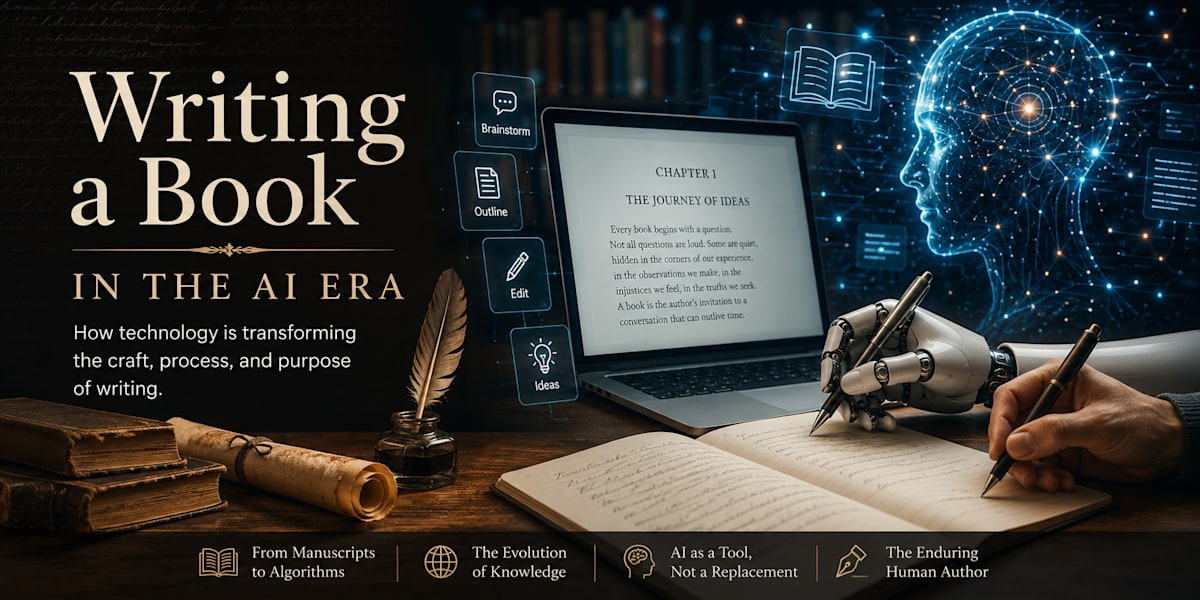
Human civilization has always been shaped by the way knowledge is created, preserved, and transmitted. Every great transformation in human history has been accompanied by a revolution in the medium of knowledge. From oral traditions to manuscripts, from printing machines to digital platforms, and now from human-computer interaction to artificial intelligence, the journey of books is essentially the journey of human consciousness itself.
In today’s era, artificial intelligence has become one of the most influential instruments in intellectual production. AI is no longer merely a machine that processes information; it has become a companion in the construction of ideas, the organization of knowledge, and the acceleration of writing. Across the world, books assisted or generated by AI have begun to appear in digital marketplaces. This phenomenon raises a fundamental question: What does it mean to be an author when machines can also produce texts?
To answer this question, we must first return to the long history of the book itself.
In the earliest periods of civilization, writing was not a simple activity. Knowledge was preserved through difficult and time-consuming processes. Before paper existed, humans recorded their ideas on stone, clay tablets, papyrus, parchment, and animal skins. Every manuscript required extraordinary effort. A book was not merely an object; it was a symbol of dedication, patience, and intellectual discipline.
At that time, knowledge moved slowly. A single manuscript could require months or even years to complete. The transmission of ideas depended on the hands of scribes who copied texts manually. Libraries were rare centers of civilization, and access to knowledge was often limited to certain groups of society.
The invention of paper transformed this relationship between humanity and knowledge. Ideas became easier to record and distribute. Later, the development of printing technology created one of the greatest revolutions in intellectual history. Machines allowed books to travel beyond geographical boundaries. Thoughts that once belonged only to a small circle could now reach readers across nations and cultures.
The printing revolution changed not only how books were produced but also how humans understood knowledge itself. A book became a bridge between civilizations. Through books, philosophers, scientists, theologians, historians, and thinkers continued conversations across centuries. The human mind was no longer restricted by time and place.
Then came another major transformation: the age of mechanical reproduction and computers.
With photocopying technology, books became even more accessible. Knowledge could be duplicated quickly and distributed widely. The arrival of computers created another leap forward. Writing no longer depended entirely on physical materials. Authors could draft, edit, store, and reproduce their ideas through digital machines.
The computer changed the psychology of writing. Before this period, writing was a slower and more permanent process. Every correction required effort. But digital writing introduced flexibility. Ideas could be revised endlessly. Text became something dynamic, constantly developing and changing.
At this stage, machines had already become part of human intellectual activity. They did not replace the human mind; they expanded human capability. The relationship between humans and technology became increasingly inseparable.
However, the emergence of the internet created an even greater transformation. Knowledge entered a new dimension where space and time became almost irrelevant.
Before the internet, access to books was determined by geography and economic conditions. Students and researchers in many parts of the world often struggled to obtain important works published in major intellectual centers. The internet changed this reality. Digital libraries, online archives, and electronic books created a new ecosystem of knowledge.
The PDF era became one of the most important moments in the democratization of information. Millions of books entered digital circulation. Readers began building personal digital libraries. Academic materials, classical texts, and contemporary works became available with unprecedented speed.
Of course, this transformation also created new challenges. The distinction between legal and illegal distribution became a serious issue. The value of intellectual property entered a complicated debate. Nevertheless, one thing was undeniable: human interaction with books had permanently changed.
Books were no longer only physical objects placed on shelves. They became digital entities existing in a new intellectual environment.
Today, we are witnessing another historical turning point: the rise of artificial intelligence.
Unlike previous technologies, AI does not simply store or distribute knowledge. It participates in the process of knowledge production itself. Machine learning systems analyze enormous amounts of information, recognize patterns, generate language, and assist humans in transforming ideas into structured writing.
This development creates both excitement and anxiety.
Some people believe that AI represents the decline of human creativity. They worry that books will lose their authenticity if machines participate in their creation. Others see AI as a continuation of the long history of intellectual tools created by humanity.
The real question is not whether AI can write. The deeper question is whether humans still have something meaningful to say.
A powerful book has never been only a collection of sentences. A book carries experience, perspective, interpretation, and vision. Technology can help arrange language, but the direction of thought still comes from human consciousness.
AI can accelerate writing, but it cannot replace the intellectual journey behind an idea. It does not experience history, culture, suffering, spirituality, or the complexity of human existence in the way humans do. The author remains responsible for meaning.
Therefore, writing in the AI era requires a new understanding of authorship. The modern author is no longer someone who simply writes words manually. The author becomes a thinker who manages knowledge, evaluates information, develops arguments, and gives direction to technological assistance.
The relationship between humans and AI should not be understood as a competition. It should be understood as collaboration.
Just as paper did not destroy human memory, the printing machine did not destroy scholarship, and computers did not eliminate writers, AI will not necessarily eliminate authors. Instead, it challenges authors to redefine the depth and originality of their ideas.
In the future, the value of a book may not depend only on how it was produced, but on the intellectual quality behind it. Readers will continue searching for insight, wisdom, and perspectives that help them understand the world.
Artificial intelligence may change the method of writing, but the search for meaning remains a human journey.
The history of books has always been the history of transformation. From animal skins to printed pages, from libraries to digital platforms, and now from human imagination to artificial intelligence, every era introduces new instruments.
But behind every instrument remains the same fundamental mission: humanity’s desire to understand itself and the universe around it.
Writing a book in the AI era is not the end of human authorship. It is another chapter in the long story of how humans create, preserve, and share knowledge.