What holds together the diverse Muslim societies of the Malay world across centuries of migration, trade, scholarship, and political transformation?
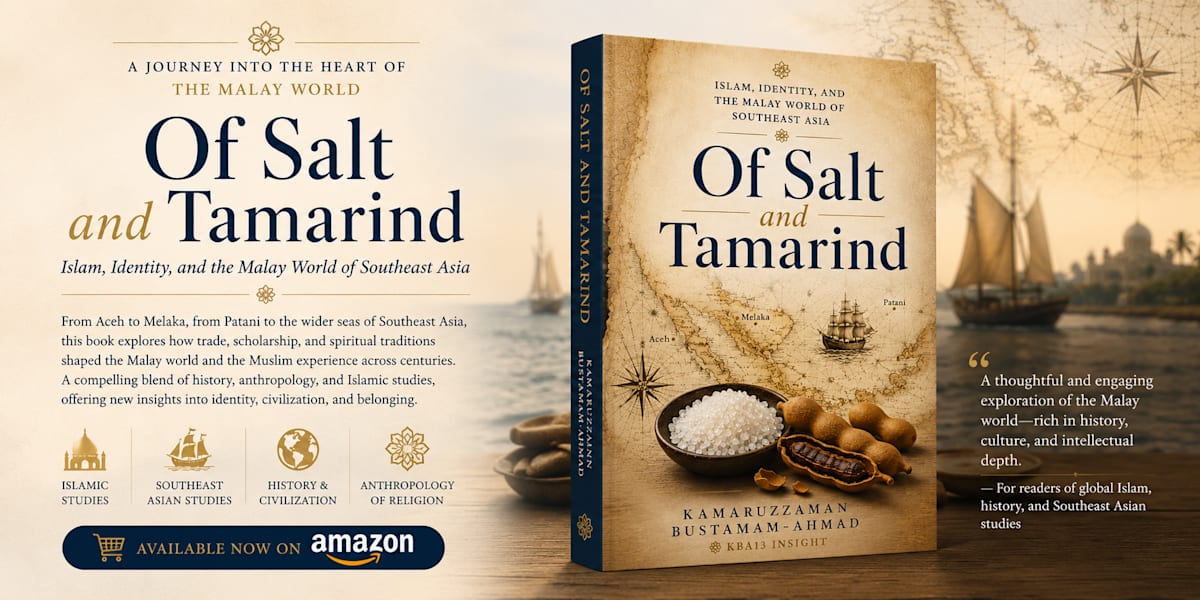
Of Salt and Tamarind explores the historical and intellectual foundations of Islam and identity in Southeast Asia, moving across the shores of Aceh, the ports of Melaka, and the historical landscapes of Patani. Rather than treating these regions as isolated national histories, the book approaches them as parts of a wider civilizational world connected through commerce, religious learning, mobility, and cultural exchange.
Salt and tamarind—two ordinary ingredients deeply embedded in everyday life across the region—serve as metaphors for continuity and change, memory and movement, and locality and cosmopolitanism. Through these metaphors, the book examines how the Malay world emerged as one of the most dynamic Islamic regions in the Indian Ocean and how its intellectual traditions continue to shape contemporary debates on identity, citizenship, and belonging.
Bringing together perspectives from anthropology, history, Islamic studies, and Southeast Asian studies, Of Salt and Tamarind offers a fresh reading of the Malay Muslim experience in an age of globalization, digital transformation, and shifting geopolitical realities.
This book will be of interest to scholars, students, and general readers interested in:
• Islam in Southeast Asia
• The Malay World and Malay Civilization
• Muslim Identity and Social Change
• Aceh, Melaka, and Patani Studies
• Anthropology of Religion
• Islamic Intellectual History
• Indian Ocean Connections
• Southeast Asian Studies
Of Salt and Tamarind invites readers to reconsider Southeast Asia not merely as a collection of nation-states, but as an interconnected civilizational space whose historical memory continues to shape the future of the region.