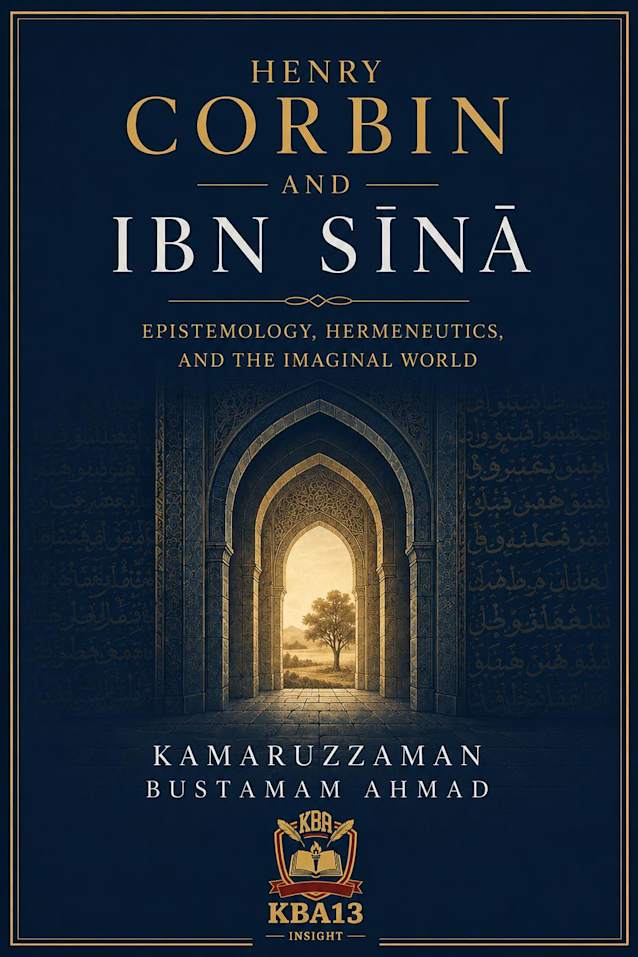
Henry Corbin and Ibn Sīnā Epistemology, Hermeneutics, and Imaginal World
About
Henry Corbin and Ibn Sīnā: Epistemology, Hermeneutics, and the Imaginal World
A philosophical journey into knowledge, imagination, and the transformation of human understanding.
For centuries, Ibn Sīnā (Avicenna) has stood as one of the greatest figures of Islamic philosophy, celebrated for his contributions to metaphysics, logic, medicine, and the architecture of rational thought. Yet behind this familiar image lies a deeper philosophical question: was Ibn Sīnā merely a philosopher of abstract reason, or did his thought also contain a vision of knowledge as an inner journey of transformation?
In this volume, Kamaruzzaman Bustamam Ahmad examines Henry Corbin’s profound reinterpretation of Ibn Sīnā and his attempt to recover dimensions of Avicennian philosophy often neglected by purely rationalist readings.
For Corbin, philosophy was not only a construction of concepts but an encounter with meaning. Through Ibn Sīnā’s visionary narratives, symbolic language, and metaphysical imagination, Corbin revealed another dimension of Islamic philosophy—one where knowing is inseparable from the transformation of the knowing subject.
This book explores:
• the philosophical encounter between Henry Corbin and Ibn Sīnā;
• the role of hermeneutics in understanding Islamic intellectual traditions;
• the meaning of the imaginal world (mundus imaginalis) as a philosophical category;
• symbolic narration as a mode of philosophical expression;
• the relationship between reason, imagination, and spiritual intelligence;
• The possibility of understanding knowledge beyond reductionist frameworks.
Rather than presenting philosophy as a closed system of doctrines, Henry Corbin and Ibn Sīnā invite readers to rediscover philosophy as a living inquiry—an intellectual path where reason, imagination, and existence meet.
As part of the Henry Corbin Studies Series, this volume contributes to a broader exploration of Islamic philosophy and its relevance for contemporary discussions on knowledge, consciousness, and the human search for meaning.
A thoughtful work for readers of Islamic philosophy, comparative philosophy, religious studies, intellectual history, and anyone interested in the enduring dialogue between classical wisdom and modern thought.