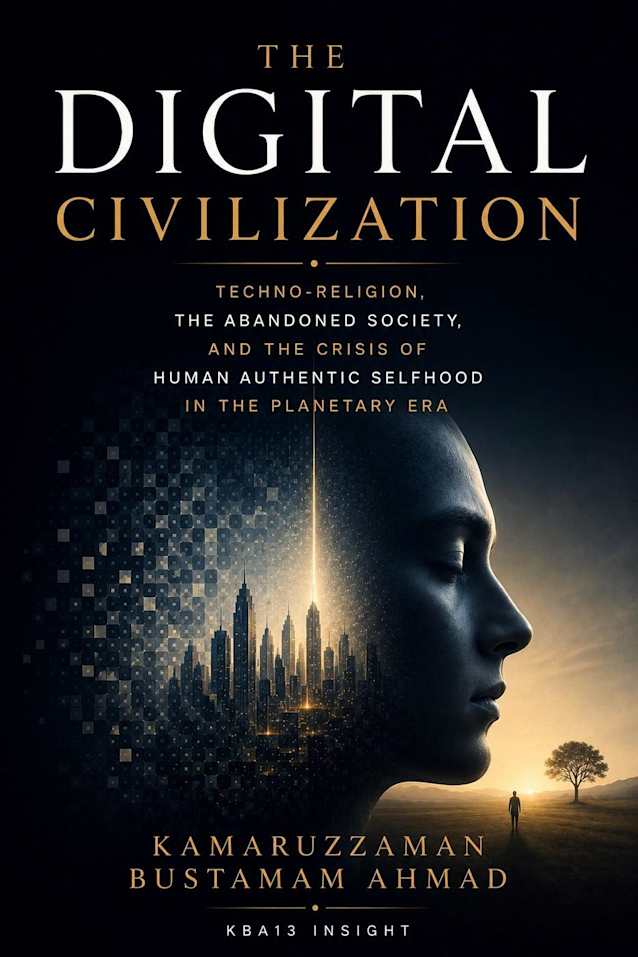
THE DIGITAL CIVILIZATION: Techno-Religion, the Abandoned Society, and the Crisis of Human Authentic Selfhood in the Planetary Era
About
What happens when technology is no longer merely a tool — but becomes the invisible architecture of human civilization?
In the age of artificial intelligence, algorithms, digital platforms, and planetary networks, humanity is entering a transformation deeper than a technological revolution. We are witnessing the birth of a new digital civilization — one that reshapes identity, belief, power, society, and even the meaning of being human.
The Digital Civilization: Techno-Religion, the Abandoned Society, and the Crisis of Human Authentic Selfhood in the Planetary Era offers a bold and original exploration of the greatest challenge of the twenty-first century: how humanity can preserve its freedom, dignity, and spiritual depth in an age increasingly governed by algorithms.
Kamaruzzaman Bustamam Ahmad introduces the concept of Techno-Religion — the moment when technology moves beyond function and begins to operate as a system of belief, authority, and meaning. From Silicon Valley’s digital visions to artificial intelligence, data capitalism, and algorithmic governance, this book examines how technology is creating new structures of power that influence the future of human civilization.
But this is also a story about those left behind.
Through the framework of the Abandoned Society, the book investigates digital inequality, digital colonialism, platform power, and the new forms of exclusion emerging within the global digital economy. It challenges the assumption that technological progress automatically creates a better world and asks a deeper question:
Are humans shaping technology — or is technology beginning to shape humanity?
Combining insights from anthropology, philosophy, religious studies, artificial intelligence, geopolitics, and future studies, this book explores:
• The rise of technology as a new civilizational force
• Artificial intelligence and the future of human identity
• The relationship between algorithms, freedom, and society
• Digital colonialism and the global data economy
• The struggle between human authenticity and technological optimization
• Southeast Asia and the Muslim world in the digital transformation
• Possible futures of planetary civilization
At its heart, The Digital Civilization argues that the future cannot be determined by algorithms alone. Humanity must rediscover wisdom, ethics, community, and spiritual imagination to build a digital world that serves human beings rather than replacing them.
For readers interested in artificial intelligence, digital transformation, philosophy of technology, future civilization, digital society, and the relationship between religion and technology, this book offers a profound reflection on the defining question of our era:
In a world ruled by data, what does it still mean to be human?