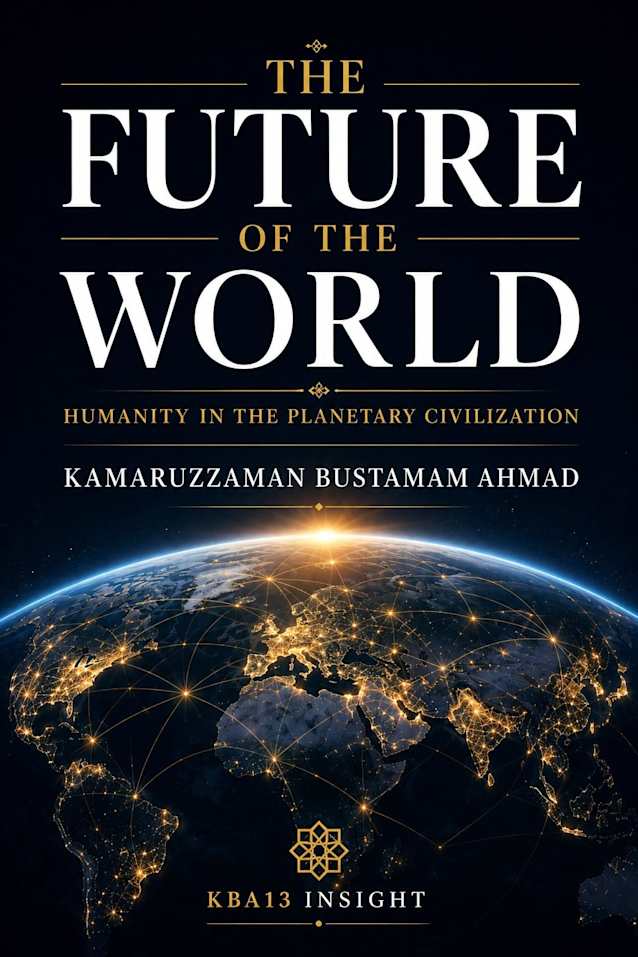
THE FUTURE OF THE WORLD: Humanity in the Planetary Civilization (Civilization & Future Studies Series Book 5)
About
What happens when humanity ceases to belong primarily to nations and begins to belong to a planetary civilization?
In The Future of the World: Humanity in the Planetary Civilization, KAMARUZZAMAN BUSTAMAM AHMAD explores one of the defining questions of the twenty-first century: how technological transformation, artificial intelligence, geopolitical competition, digital networks, and the engineering of human consciousness are reshaping the future of civilization itself.
This book moves beyond conventional discussions of technology and innovation. Instead, it examines the deeper transformation occurring beneath contemporary history: the emergence of a new planetary order in which borders become increasingly porous, information circulates at unprecedented speed, and human beings find themselves living simultaneously in local, national, and global realities.
Drawing upon insights from futures studies, geopolitics, anthropology, intelligence studies, and the philosophy of civilization, the author investigates critical questions facing humanity:
• How will artificial intelligence reshape human consciousness and decision-making?
• Can human autonomy survive the age of algorithmic governance?
• What happens when human behavior itself becomes an object of engineering?
• Will future conflicts occur primarily between states, or between competing systems of thought and consciousness?
• What kind of human being will emerge from the Planetary Civilization?
From the reproduction of human consciousness to the transformation of social behavior, this book offers a long-range intellectual map of the world that is now emerging around us.
Rather than presenting technological optimism or civilizational pessimism, The Future of the World invites readers to think historically, strategically, and philosophically about humanity’s place in a rapidly changing world.
Written for scholars, policymakers, strategists, students, and general readers interested in the future of humanity, artificial intelligence, geopolitics, global civilization, and the transformation of human society, this book offers a distinctive perspective from Southeast Asia on questions that belong to the entire world.
The future is no longer approaching.
It has already begun.